
Saturated magenta colour
High saturation supports magenta colour development in digital graphics. Assess the final shade in the intended ink vehicle and alongside the other formulation colours.
Quinacridone / Organic pigment powder
A high-saturation quinacridone pigment powder with excellent lightfastness and a stable crystal structure, developed for UV and aqueous inkjet colour systems.
Standard packaging · 10 kg paper bag
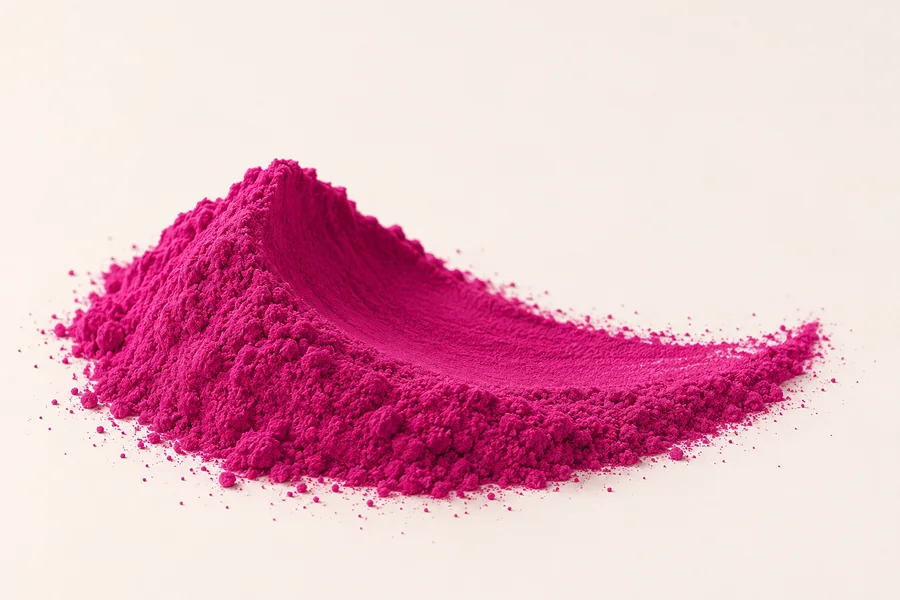
Grade overview
Superperm Pink EC brings vivid, blue-shade Pigment Red 122 magenta to Huabao's digital colour range. Compared with our PV19 R-type grade, it has a cooler, bluer shade. Its current TDS highlights high saturation, excellent lightfastness and a stable crystal form and structure, with full-shade light resistance of 8/8. Supplied as powder for downstream dispersion manufacture and ink formulation, the grade's published applications cover UV inkjet graphics and aqueous production printing.
High saturation supports magenta colour development in digital graphics. Assess the final shade in the intended ink vehicle and alongside the other formulation colours.
The TDS identifies a stable crystal form and structure, supporting the grade's positioning as a consistent colour raw material for dispersion and ink developers.
The published pigment data combines 8/8 full-shade light resistance with 5/5 weather, acid and alkali resistance. These characteristics support lasting colour in properly formulated printing systems.
Technical profile
| Property | Reference value | Condition / reference |
|---|---|---|
| Colour Index | Pigment Red 122 / PR122 | |
| CAS number | 980-26-7 | |
| Chemical family | Quinacridone | Organic pigment powder |
| Shade direction | Blue-shade magenta | Manufacturer clarification; cooler and bluer than our PV19 R-type grade |
| Density | 1.3–1.5 g/cm³ | TDS value |
| Specific surface area | 62 m²/g | TDS value |
| Oil absorption | 40–60 g/100 g | TDS value |
| pH | 5–8 | Test medium and concentration not specified in the TDS |
| Light resistance | 8/8 | Full shade |
| Weather resistance | 5/5 | TDS rating |
| Heat resistance | 200 °C | Test medium and duration not specified in the TDS |
| Acid resistance | 5/5 | TDS rating |
| Alkali resistance | 5/5 | TDS rating |
| Standard packaging | 10 kg paper bag | As listed in the TDS |
Data: current Superperm Pink EC TDS and SDS. Values are technical references, not batch COA results. Evaluate application suitability in the customer's dispersion and ink system.
Formulation opportunities
The current TDS lists signage, packaging and labels, decorative surfaces, UV DTF, promotional gifts, automotive applications, colour marking and art reproduction as development directions.
A magenta pigment raw material for textile digital printing ink development. The downstream dispersion, binder and fixation process are selected for the fabric, transfer process and required print durability.
Published aqueous directions include POD web-fed paper printing, corrugated box printing and desktop office printing, offering development opportunities for colour ink makers.
Technical guidance & test reports
Read the context for Huabao's company-reported laboratory grafting rate of up to 75% and the subsequent aqueous formulation evaluation.
View the grafting trial summaryView PR122 samples after carboxylic or phosphate grafting and particle-size control, including the reported D10, D50, D90 and D97 values.
View customer particle-size reportsCompare stabilising chemistry, pigment loading and vehicle compatibility when choosing how to develop an aqueous PR122 dispersion.
Compare the two dispersion routesReview how pigment crystal form, colour measurement and repeat-lot comparisons relate to the target magenta shade.
Read the colour and crystal-form guideTechnical & regulatory documents
Current Superperm Pink EC technical data, including UV and aqueous inkjet application guidance.
PR122 TDS (PDF) · 0.4 MBSafety, handling, storage and transport information for Superperm Pink EC.
Document date · 2020-03-21
PR122 SDS (PDF) · 0.2 MBPR122 substance registration confirmation: 01-2119456804-33-0029. Review the original letter for applicability and conditions.
Document date · 2023-03-09
View PR122 PDF · 0.1 MBSeparate results for submitted PR122 and PV19 RP samples within a four-sample report. See SHAH01820317 for exact sample identities and limits.
Document date · 2025-05-21
View PR122 & PV19 RP PDF · 0.6 MBSVHC screening of the submitted PR122 sample. See report A2250076443101001E for the substance list, sample details and reporting limits.
Document date · 2025-02-21
View PR122 PDF · 1.8 MBRegistration and test documents refer to the substances or samples identified in each file. Request the documentation relevant to your grade, batch and intended use.
Supply & handling
10 kg paper bag, as specified in the current TDS.
Keep sealed and protected from light and moisture. The SDS specifies cool, dry, well-ventilated storage at or below 30 °C.
Request a supply quotationProduct questions
The current TDS lists both UV and water-based inkjet applications. Each route requires a dispersion and vehicle suited to that ink chemistry. Share the intended formulation system so that sample evaluation can focus on the relevant process.
The 8/8 value is the TDS full-shade pigment rating. Assess the finished textile print in the selected formulation, fabric and fixation system, including washing and dry/wet rubbing where relevant.
Identify PR122 and Superperm Pink EC, your destination market and intended use. Review the TDS, SDS and related registration or sample test documents together. PR122 KKDIK registration information is also available on request.
Huabao reports a carboxylic grafting rate of up to 75% for PR122 in laboratory evaluations, with strong dispersion stability in those trials. This supports development of surface-modified aqueous colourants. Compare results using an agreed grafting-rate definition and analytical method, then evaluate the dispersion in the intended ink vehicle.
Use the intended ink vehicle and final pigment loading as the basis for comparison. For surface modification, assess treatment response and stability. For encapsulation, assess the chosen polymer and processing route. Compare filtration, viscosity and particle-size distribution after storage, followed by jetting and print performance in the target system.
The self-dispersion article includes customer PR122 sample reports after carboxylic or phosphate grafting and particle-size control. Read the upper percentiles alongside the median. These reports describe the processed customer samples. Use matched measurement methods and sample preparation when comparing them with your own development results.
Share your ink system, substrate and target colour. We can help you choose a powder grade and find its technical documents.
Explore the range
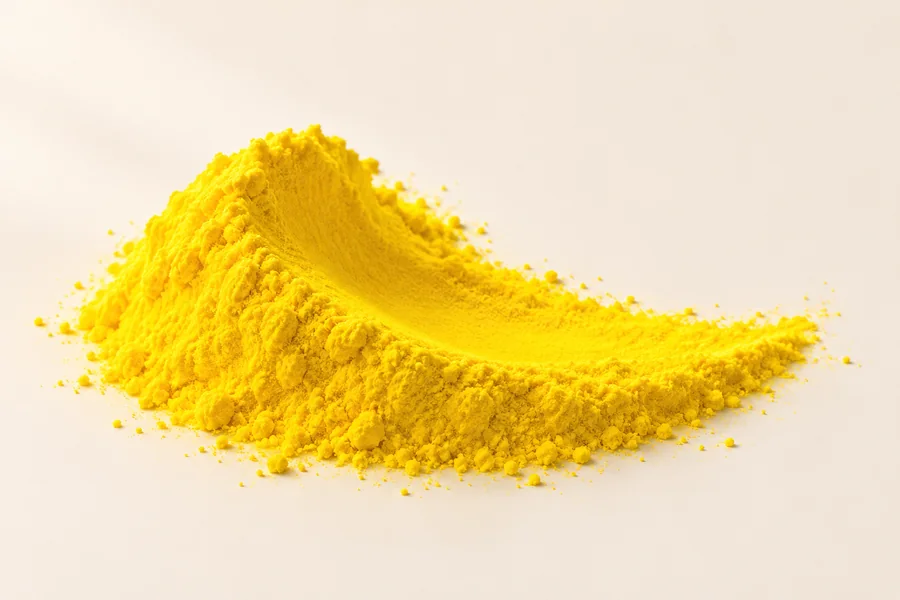 Benzimidazolone
Pigment Yellow 180
Transparent yellow for printing and inkjet ink development.
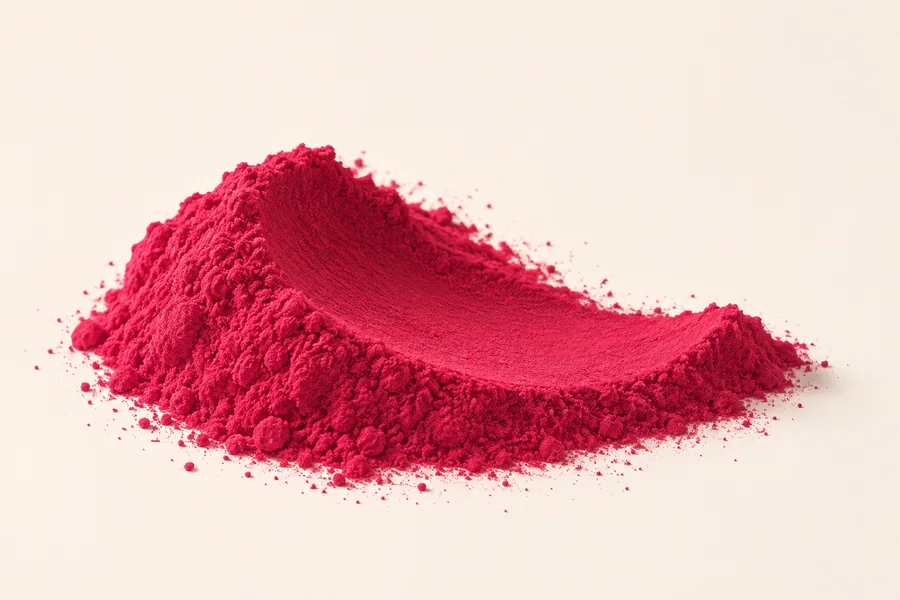 Quinacridone
Pigment Violet 19
R-type PV19: a warmer magenta shade, less violet than beta-type PV19.