
A warmer magenta shade
Our R-type PV19 offers a warmer, more yellowish magenta direction than our PR122. It is less violet than beta-type PV19. Compare physical samples in the same vehicle to select the shade for your colour palette.
Quinacridone / Organic pigment powder
An R-type PV19 quinacridone pigment powder with a warmer, more yellowish shade than our blue-shade PR122 and less violet character than beta-type PV19, for UV and aqueous inkjet development.
Standard packaging · 10 kg compound bag
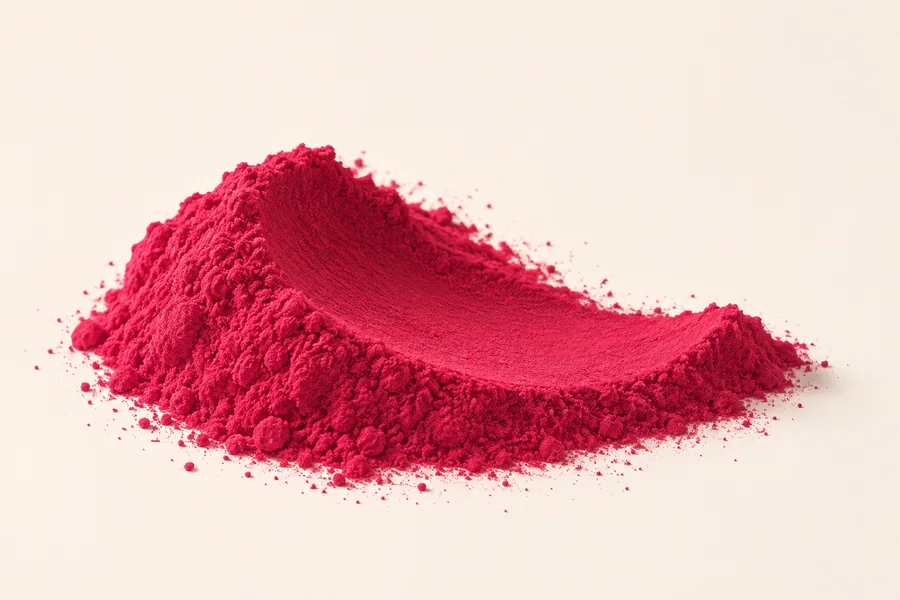
Grade overview
Superfast Violet RP is Huabao's R-type Pigment Violet 19 grade. Its colour is warmer and more yellowish than our blue-shade PR122, with less violet character than beta-type PV19. This shade distinction helps formulators choose between two different magenta directions. The TDS highlights high saturation, high lightfastness and stable crystal character, and lists UV and water-based inkjet applications. Its published average pigment particle size is 105 nm. We supply the pigment powder for downstream dispersion development and ink formulation.
Our R-type PV19 offers a warmer, more yellowish magenta direction than our PR122. It is less violet than beta-type PV19. Compare physical samples in the same vehicle to select the shade for your colour palette.
The TDS describes high lightfastness alongside stable crystal character. It is a strong basis for positioning this grade around lasting colour, with the finished print assessed in its own formulation and application.
The published average pigment particle size is 105 nm. Dispersion developers can use this and the 70 m²/g specific surface area when planning processing and evaluation.
Technical profile
| Property | Reference value | Condition / reference |
|---|---|---|
| Colour Index | Pigment Violet 19 / PV19 | |
| CAS number | 1047-16-1 | |
| Chemical family | Quinacridone | Organic pigment powder |
| Grade / shade direction | R-type PV19 / warm magenta | Manufacturer-confirmed shade: warmer than our PR122; less violet than beta-type PV19 |
| Density | 1.4–1.6 g/cm³ | TDS value |
| Specific surface area | 70 m²/g | TDS value |
| Average pigment particle size | 105 nm | TDS average; measurement method and statistical basis not specified. Not a D50 or a finished-ink size distribution. |
| Heat resistance | 300 °C | HDPE, 5 minutes |
| Weather resistance | 5 | Reduction; rating scale not specified in the TDS |
| Bleeding resistance | 5 | Full shade; rating scale not specified in the TDS |
| Acid resistance | 5 | Rating scale not specified in the TDS |
| Alkali resistance | 5 | Rating scale not specified in the TDS |
| Warping in HDPE | Low | TDS description |
| Standard packaging | 10 kg compound bag | As listed in the TDS |
Technical data: current Superfast Violet RP TDS and SDS. R-type designation and relative shade comparison: manufacturer clarification. High lightfastness is described without a numerical grade. Values are pigment references, not finished-ink measurements or batch COA results.
Formulation opportunities
A warm-magenta pigment raw material for developing UV inkjet colours. Match the pigment dispersion, reactive vehicle and colour requirements to the intended graphic or decorative application.
The published aqueous application direction allows formulators to assess the grade in their chosen water-based dispersion platform, with stability, colour and print performance measured in the complete system.
Share the target substrate, dispersion method and required colour performance, keeping evaluation focused on the actual ink development project.
Technical guidance & test reports
Read the context for Huabao's company-reported laboratory grafting rate of up to 90% and the subsequent aqueous formulation evaluation.
View the grafting trial summaryView PV19 samples after carboxylic or phosphate grafting and particle-size control, with the median and upper particle-size percentiles.
View customer particle-size reportsReview the differences between chemically self-dispersed pigments and engineered polymer encapsulation for aqueous ink development.
Compare the two dispersion routesExplore R-type PV19's shade direction and the checks that connect crystal-form consistency to repeatable colour.
Read the colour and crystal-form guideTechnical & regulatory documents
Technical properties and UV and aqueous inkjet application guidance for Superfast Violet RP.
PV19 TDS (PDF) · 0.2 MBSafety, handling, storage and transport information for Superfast Violet RP.
Document date · 2020-03-21
PV19 SDS (PDF) · 0.2 MBSeparate results for submitted PR122 and PV19 RP samples within a four-sample report. See SHAH01820317 for exact sample identities and limits.
Document date · 2025-05-21
View PR122 & PV19 RP PDF · 0.6 MBRegistration and test documents refer to the substances or samples identified in each file. Request the documentation relevant to your grade, batch and intended use.
Supply & handling
10 kg compound bag, as specified in the current TDS.
The SDS specifies cool, dry, well-ventilated storage at or below 30 °C, with the container kept tightly closed.
Request a supply quotationProduct questions
Huabao supplies this grade as R-type PV19. It is warmer and more yellowish than our blue-shade PR122, and less violet than beta-type PV19. The Colour Index name remains Pigment Violet 19 and the commercial name remains Superfast Violet RP. Evaluate shade with physical samples in a matched formulation.
It is the TDS average particle-size value for the pigment, not a D50 or a finished-ink size distribution. Downstream dispersion processing and ink formulation require their own particle-size evaluation.
The stated test condition is HDPE for five minutes: a pigment property under that condition, not an inkjet operating temperature. Compare thermal properties where the test medium, duration and method are appropriately matched.
Specify Superfast Violet RP, the UV or aqueous ink vehicle, your dispersion route and the target print application. Include the required shade and evaluation priorities so the technical discussion can address your actual formulation needs.
Huabao reports a carboxylic grafting rate of up to 90% for R-type PV19 in laboratory evaluations, with strong dispersion stability in those trials. The technical article also presents customer samples after carboxylic or phosphate treatment and particle-size control. These provide development references for the intended surface chemistry and ink vehicle.
Evaluate Superfast Violet RP with the selected coating polymer and the intended aqueous vehicle. Compare colour, viscosity, particle-size distribution and filtration before and after storage. The process comparison explains how a designed polymer layer stabilises the dispersion and how this differs from attaching hydrophilic groups to the pigment surface.
Use an approved retained pigment lot and keep dispersion preparation, substrate, ink laydown and colour measurement conditions consistent. Compare hue and chroma on the same basis. Where the project requires crystal-form evidence, agree a phase-analysis method such as powder X-ray diffraction and relate the results to the retained colour reference.
Share your ink system, substrate and target colour. We can help you choose a powder grade and find its technical documents.
Explore the range
 Benzimidazolone
Pigment Yellow 180
Transparent yellow for printing and inkjet ink development.
 Quinacridone
Pigment Red 122
Blue-shade magenta with excellent lightfastness and a stable crystal form.